
This article is spot on. Fantastic operating system with a clear concept of how it should be done. And great for people that want to fight for it. But everything you want to do that’s slightly off the path is a 3 hour research project in documentation that’s pretty damn poor. It eventually wears you out.
Nixos user here for 4 years.
Yep
Its legit you want to try sway window manager?!?
Sway = true;
You want to change the keybinds and make it declarative.
MAY GOD HELP YOU.
Files.home
Is what u want and it took me 3 hours to find that
Seems like there’s now an option for that in Home-Manager: https://nix-community.github.io/home-manager/options.xhtml#opt-wayland.windowManager.sway.config.keybindings
But yeah, if you tried to use it when Sway wasn’t yet well-supported, or just want to use some obscure software in general, then yeah, things can get more complicated…
This module is actually a bit of a pet peeve of mine and a big reason I soured on Home Manager in general…
You inevitably end up writing chimera configurations like this:
# home.nix
programs.sway = {
  enable = true;

  # not supported by module - need to use escape hatch
  # good luck getting your editor to syntax highlight this snippet btw
  extraConfig = /* swayconfig */ ''
    bindgesture swipe:right workspace prev
    bindgesture swipe:left workspace next
  '';
};

programs.waybar = {
  enable = true:

  # can't do that in Nix
  style = /* css */ ''
    window#waybar {
      background: #16191C;
      color: #AAB2BF;
    }
  '';
};

# configuration.nix
# need to enable Sway a second time so the display manager can see it
# this may also install a second Sway if you fuck up your HM setup
programs.sway.enable = true;
and in exchange for this you get:
- 30s+ iteration times for basic changes like keybinds
- No ability to copy paste config snippets from READMEs/Wikis (unless you use
home.file/extraConfigescape hatches) - No ability to edit configuration in scripts (breaks a lot of theming functionality in “shells” like DMS, Noctalia, etc.)
- More ways to write configs that look right but don’t quite work or just do dumb things (extra Nixpkgs imports, duplicated packages, WMs that aren’t visible to the DM, etc.)
Alternatively you could just use a dotfile manager like rcm or stow or chezmoi like everyone not on NixOS+HM and not have to deal with any of this.
Yeah, I can understand the frustration. IMHO the Home-Manager way of doing things has some merits:
- You can (generally) manage the installation of packages together with their configuration.
- You can override individual configuration values for different machines (which I guess, you can also do via templating in chezmoi).
- Some programs don’t have a particularly readable configuration file or spread this configuration out over multiple files, or save all kinds of additional garbage into their configuration file which you don’t want to persist. Home-Manager can work around all these issues, and in such a case is likely also better documented than the original configuration file.
That last point is one that’s particularly relevant for me, because KDE Plasma’s configuration files are largely terrible. Home-Manager, together with Plasma-Manager, is the only sane way I know of, to automate the panel configuration in KDE.
But yeah, if you don’t use software with terrible configuration files, then I can certainly understand preferring dumb templating. I have also decided against using the Home-Manager-specific modules in places, or might only translate into the Home-Manager-specific module when I actually want to vary configuration values between two machines.
Just to give a quick impression of how terrible the KDE panel configuration is, this is a snippet out of the fittingly-called
plasma-org.kde.plasma.desktop-appletsrcfile:[ActionPlugins][0] MiddleButton;NoModifier=org.kde.paste RightButton;NoModifier=org.kde.contextmenu [ActionPlugins][1] RightButton;NoModifier=org.kde.contextmenu [Containments][1122] activityId=f588743a-9bab-4f56-8f90-3616085ab6e0 formfactor=0 immutability=1 lastScreen=1 location=0 plugin=org.kde.plasma.folder wallpaperplugin=org.kde.color [Containments][1122][Wallpaper][org.kde.color][General] Color=#79740eAh sorry, that doesn’t actually show any of the panel configuration, because KDE mixes configuration for the panel and desktop widgets and the Activities feature (like workspaces, but with separate wallpapers and widgets for each Activity) all into the same file.
So, here’s a snippet that actually shows the panel configuration, from just a few lines below the first snippet:[Containments][1807] activityId= formfactor=3 immutability=1 lastScreen[$i]=0 location=5 plugin=org.kde.panel wallpaperplugin=org.kde.image [Containments][1807][Applets][1808] immutability=1 plugin=org.kde.plasma.showActivityManager [Containments][1807][Applets][1810] immutability=1 plugin=org.kde.plasma.pager [Containments][1807][Applets][1810][Configuration][General] showOnlyCurrentScreen=true showWindowIcons=true wrapPage=true [Containments][1807][Applets][1811] immutability=1 plugin=org.kde.plasma.panelspacer [Containments][1807][Applets][1812] activityId= formfactor=0 immutability=1 lastScreen=-1 location=0 plugin=org.kde.plasma.systemtray popupHeight=432 popupWidth=432 wallpaperplugin=org.kde.imageWhat those numbers in e.g.
[Containments][1807][Applets][1812]are? Ah, they just count those from 0 to infinity, whenever you add a widget through the UI.
And in case you were wondering since when INI allows for nesting section keys via[multiple][brackets]: It doesn’t. That’s a custom extension of the INI format, specifically in use by KDE.Like, man, I love KDE for its features, but this is the stuff of nightmares.
Does Home Manager not just have a dot file manager built in? On Guix, I just have my Waybar config. get moved to the appropriate location that Waybar will expect it.
Some services will even allow you to specify files to get injected into the config.; like the Bash service so I can write some definitions out in a .sh file and the service inserts that contents after the boilerplate it provides into my
.bashrc.It does, that’s the
home.fileescape hatch I mentioned. But then you end up paying 10-30 seconds eval for a “config” that looks like this:{ home.file.".bashrc".source = ./bashrc; home.file.".bash_profile".source = ./bash_profile; xdg.configFile.nvim.source = ./nvim; xdg.configFile.sway.source = ./sway; # ... }I suppose there are fringe use cases where Nix attrset merging behaviour is useful, but in the average case I just don’t see much value here.
You don’t have to waste 30 seconds on a full eval when just iterating, I use these one-liners when trying to get some config file working: https://github.com/balsoft/nixos-config/blob/master/flake.nix#L140 ; they only evaluate one specific file and then link it into the right location “imperatively”
Then when I get it working I do the
nixos-rebuild switch, which is a no-op in terms of home-manager stuff because the link points to the same location, it just makes it so that it stays the same after a reboot (I use impermanence).
The CSS thing might be true, but the swayconfig file is probably a solvable problem, especially with everything being slowly moving to freeform modules. We just need to write a Nix -> swayconfig generator, which shouldn’t be too difficult because swayconfig is not even turing-complete.
Well, is it like that using home manager?
I remember home-manager integrated with flakes being a nightmare for my potato laptop because I defined even the bash alias and such stuffs in it and even if I had to change/add a simple alias I had to rebuild the whole system lol, I could have just used home-manager standalone to be honest(I forgot to do this) but I just switched to using the old way of managing dotfiles with
stow.So right now I have it defined in the
.config/sway/configfile like this:input * { xkb_layout "us" xkb_options "caps:ctrl_shifted_capslock" }Maybe I will come back to using standalone home-manager one day.
or just want to use some obscure software in general, then yeah, things can get more complicated…
Well thanks, so NixOS is not for me then.
Oof, I was just talking about making things declarative there. If you want to configure it the old-fashioned way, like you would on other distros, then those difficulties don’t apply.
In more general terms, though, it’s a bit of a double-edged sword. The Nix package repository has more packages than other package managers: https://repology.org/repositories/graphs
So, the chance of finding an obscure software, that’s already packaged, is rather high.
Here’s the online package search, if you want to check the availability of some of the obscure software you use: https://search.nixos.org/packagesBut then, yeah, the flipside is that, from what I understand, you can’t just download a random executable off of the internet and run it, because of the Filesystem Hierarchy Standard not being adhered to, as the post also mentions.
You can set up Flatpaks, and I believe AppImages would work, because those also live in their own FUSE filesystem. Well, and there is ways to emulate the FHS layout to get normal applications to run, too.But yeah, way out of my field of expertise there. I have only one software installed which isn’t packaged for Nix, which is a program I wrote myself.
And to get sufficient FHS emulation for that, I just needed this line in my config:programs.nix-ld.enable = true;More complex programs will need a bit of extra configuration: https://wiki.nixos.org/wiki/Nix-ld
(I could also add a
flake.nixfile into my software’s repository, though, which would make it so it could be installed straight from my repo, as if it was packaged.)
I love NixOS but it really does make the hard things easy and the easy things hard. I even take “vacations” from it. Like right now for example. I switched back to Arch for a bit as I found myself spending too much time playing around with my various nix configurations/modules and also getting frustrated in trying to get some random application to work. So went back to Arch so I don’t have to think about stuff.
the beauty of NixOS is I can go back to it and be exactly where I left off in like 15minutes. I just need a break from it.
This reminds me of something I might have said of pre-alpha Gentoo days.
Gentoo is well documented and works almost out of the box.
Sure it is now, but it was not always. Gentoo didnt just spring forth from the aether full-grown.
pre-alpha
The period of pre-0.1 that I reference above, ended in 2002 with the release of 0.1 Alpha. This is back when the idea of adding a binary installer was controversial in the gentoo community. That was 24 years ago, in case you are following along. So going on about the current state of Gentoo is not super relevant. I am glad it is better, but I am old enough to remember when it was a pretty gnarly ball of yarn and that is what I mentioned.
I gave nixos a shot and pretty immediately noped out. All I wanted as a starting point was nvim with lazyvim. And as you said, it was a huge research project and after an hour with no luck, I nuked it.
I feel like it’s actually not that hard… if you can tell what advice is bad and shouldn’t be followed. Which I realize is a major catch-22 for new users.
My honest advice on Neovim (for everyone) is to do this:
environment.systemPackages = [ pkgs.neovim ];- Configure Neovim as you usually would (hand-written
init.lua, Lazyvim installer, whatever) - Ignore/Disable Meson and use shell.nix to get language servers and formatters instead (alternatively: enable nix-ld for Meson or Mise)
- Completely ignore all the wrapper garbage like
programs.neovim, nixvim, nvf, nixCats, and all the others
The last one is important. You can try all you want to make the garbage work and it eventually will, at least kinda, but IMHO the very idea of what they’re trying to do is bad, ultimately making them a colossal waste of time.
I have less strong but overall similar feelings regarding Home Manager, those newly hyped wrapper managers and libraries, the “Dendritic Pattern”, etc. The NixOS community loves coming up with novel ways to shoot themselves in the foot.
Is there no forum or discord for the distro? Or a self help book. Way back in the day that’s how i did shit on slackware. Irc and books.
There’s a forum, which is fine, but the people on there are very insistent that you should do things “the nix way” and if you don’t go all in on that then you get chastised.
A bit of friction when going off the beaten path is generally a good thing. Some people always take this too far though
you should do things [their way] and if you don’t go all in on that then you get chastised.
As is tradition.
There’s a manual, a discourse (forum) and a Matrix. And an unofficial subreddit and a Lemmy community. As well as two wikis and a large number of random people writing blog posts and tutorials.
This might be a hot take but honestly I think the documentation quality isn’t the problem. You can point to specific topics that aren’t well documented but that isn’t unusual. What’s unusual is how NixOS is designed and how working around its quirks requires close to distro maintainer levels of knowledge.
Most distros don’t require several pages of documentation on how to install a Python application. NixOS on the other hand…
Most distros don’t require several pages of documentation on how to install a Python application. NixOS on the other hand…
Ooof. Ok now I understand a bit. Thanks.
Pretty sure there’s an unofficial discord server with around 16k members.
Damn right. And the Nixos community forums are full of people unwilling to accept this. They will gaslight you into thinking you’re the problem. “Just do this”, as I’d it’s completely obvious and you’re dumb for not realising that. Of course if they find out you have some ideological incompatibility with them, you’re out anyway.
NIXOS really needs a fork. One that embraces or rejects flakes outright. One that stops inviting ideological battles. And one that embraces documentation.
I mean, you don’t really need a fork for that. Anyone who’s motivated to actually improve the situation here, can just write appropriate documentation.
I guess, a fork would give you a new name, and therefore a clean slate where there’s not loads of contradicting information already out there. But yeah, that’s also a lot of work…
Well, I’m not in Microslop platforms, so that’s going to be difficult.
Second, the way things work in the current nix/nixos community make it easy to create a PR but very difficult to get it merged. Attempts at writing documentation are nitpicked to death, unless you belong to the privileged class of the documentation team or have merge rights on Microslop’s Github.
A fork would also give an attempt at forming a new community with different rules and focus.
Do you have some specific threads in mind? Maybe I’m lucky to never click on the bad ones but my experience is that nobody is more cynical regarding Nix/NixOS jank than the long time NixOS users. You might not always get the answer you want, because it is very jank and doing some things will get you into trouble. But people pointing that out isn’t the same thing as gaslighting.
Guix SD might be worth a look, it seems to be just straight up better in many technical regards. It has no flakes, comprehensive documentation and a blessed way to manage user homes. At least as long as you don’t really need WiFi of course…
I’m using GuixSD on my desktop, and while I think it’s better in terms of creating stuff that doesn’t already exist in upstream repos, there’s so much functionality missing that’s present in nixpkgs and random flakes online that for the average person complaining about Nix jank it’s very likely not worth the effort. On the bright side they released 1.5 recently so you no longer have to use a 3 year old image (that likely doesn’t work right if your computer is too new) or a nightly one to get things running.
At least as long as you don’t really need WiFi of course…
Hey, now – the NonGuix repo. exists!
_
For those unfamiliar, it contains software with proprietary elements that otherwise can’t make it into the Guix software repository, à la
non-freefor Debian.You can get the normal Linux kernel and all the hardware compatibility you’d typically expect easily through NonGuix.
For some reason, stuff like libre wolf isn’t in the guix repo. Not even Firefox. It’s very confusing.
Firefox’s use of Encrypted Media Extensions violates the GNU Free System Distribution Guidelines as it allows for playing of DRM-protected content which can steer people to non-free software (there may be additional other reasons but that’s one I definitely know of).
But it’s perfectly available in NonGuix; I use Firefox regularly on Guix.
As for Librewolf, I’m not sure that’s accurate? I see it available in the default Guix repo.s, latest version: https://packages.guix.gnu.org/packages/librewolf/.
It was added about 2 years ago. Admittedly, Guix is a smaller distro so some packages aren’t packaged immediately just as a consequence of a lack of human resources; but it also continues to improve over time, quite nicely.
It’s been a while since I left the forums, but there always seems to be drama and something going on. I didn’t the community to be very helpful and inviting. It left a very bad taste in my mouth and in mostly avoid it. Now I ask LLMs to whip something up when in need it.
At least as long as you don’t really need WiFi of course…
I thought that was a solved problem on Linux. Is it the reluctance to use binary blobs?
I thought that was a solved problem on Linux. Is it the reluctance to use binary blobs?
Yes. For the same reason you also don’t get firmware updates on Guix. Or Firefox.
You are thinking of the better alternative, guix
I’m not that much a fan of brackets and jumping through hoops to install anything non-GNU.
There are forks of Nix. Perhaps you might like Lix.
I haven’t yet found out where its major differences lie. And it seems like they haven’t taken a firm stance on flakes (yes or no). They also only forked the interpreter, not nixpkgs. A good step, but their documentation wasn’t good, the last time I checked.
One that stops inviting ideological battles
That’s impossible IMHO. Nix is fundamentally about doing things “the right way”, and so there will always be disagreements about what “the right way” is. I think they are bound to be eventually settled on the best possible answer, you don’t need a fork for that.
If only the battles were about software. They are about unrelated beliefs and political ideologies. I’d very much prefer ideological battles about software trust me.
The problem is that NixOS achieves all of this by breaking assumptions that almost all Linux software relies on. Most Linux binaries assume the Filesystem Hierarchy Standard exists, and they expect interpreters and libraries at fixed global paths.
This is a problem of those applications, we began to make appimages that do not make those assumptions and work in NixOS directly. (And this also means it works in places like alpine where a lot of those binaries wont either).
People like to throw the FHS around but the reality is that not a single distro follows it fully, I wouldn’t rely on it to be the same in the near future at all.
Most of these are still relevant issues afaik, so yeah… appimages are just not a solution for everything. Same as stuff like flatpak and snap. These are nice for when you just need some little standalone app that doesnt do a lot of compute heavy stuff, but they will never replace native implementations.
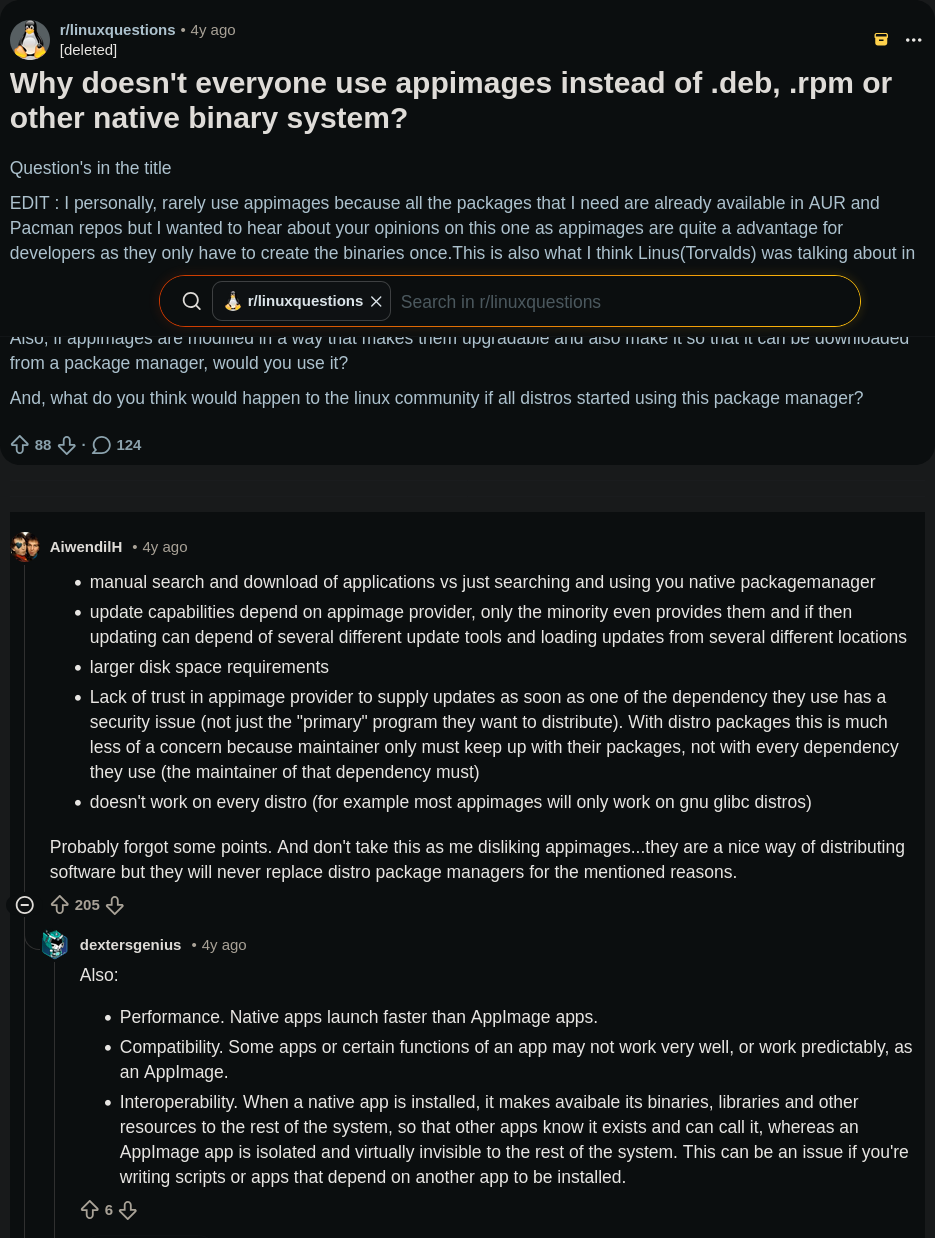
The points in the screenshot are just false and outdated, the guy even says that it doesn’t work on every distro lol
This is signal made with sharun working on ubuntu 12.04 a 14 year old distro: https://imgur.com/a/1f5S0P7 The distro is so old that internet no longer worked lol, had to use a flash drive to transfer the appimage.
we use a lot less storage than flatpak and this comparison is outdated, we have reduced the size of a lot of apps since then.
I actually did a quick test installing an alpine linux container and about 10 GUI apps vs appimage and appimage used less storage, now this comparison was flawed because I later realized that the alpine stable repo was super old and for example GIMP was pulling the gtk2 version instead of the gtk3 one (which brings all of gtk2 into the system instead of sharing the existing gtk3) but you get the idea of how close we are.
For updates and desktop integration use AM or soar
but they will never replace native implementations.
Eden makes its appimage using sharun, they made it with PGO optimizations on it which has a ~10% increase in FPS.
native implementations wouldn’t bother doing this, in fact PCSX2 had to tell people to not use the official archlinux package while it existed, because archlinux compiled it with generic flags which was horrible lol
This is also the reason why this benchmark showed appimage performing much better, you are free to optimize your application, while distros packages, flatpak, etc you often have to deal with packaging policies that do not allow this:
https://www.reddit.com/r/linux/comments/u5gr7r/interesting_benchmarks_of_flatpak_vs_snap_vs/
At this point, FHS feels more like a hindrance to me. Also, it was made in a time with very limited disk capacity and personal computers weren’t much of a thing yet.
@MonkderVierte @Samueru_sama I don’t think the standard (more like a guideline) is bad in itself: consistence of file-system use across applications is good for all our sanity. It is the assumption that all applications use it rigorously that is the problem. The word is SHOULD, not MUST.
While i agree that a standard is useful, i think the FHS is out of date: it has lot’s of fragmentation where it is not needed anymore, instead of keeping it simple. And also lots of reinterpretations, which makes it even more confusing.
Which results in some people who learned FHS thing (but never why it happened) keeping slave-ish to it and doing nonsense in major distros. Which, again, results in small niche distro being forced to it too, because they lack the manpower to adapt the tooling.
Switching is hard, but going back is impossible.
I never want to go back to an OS I can’t diff or track under revision control. I just love being able to solve an issue once and move on without worrying about if I’ll forget all the minutiae of changes I made to my customized system when it eventually comes to migrating workstations or replicating across my computers.
Lol love the title.
I feel the same about KDE on Wayland, it’s amazing but it’s not stable enough yet.
Took my laptop to work and it had a stroke when I plugged it into the office monitors
That’s weird.
To share a contrasting experience, I run KDE on Wayland on a laptop with two physical monitors with different rotations and three virtual monitors with different resolutions and it all Just Works.I have a Nvidia GPU, and the monitors are work are old-ish
Might be the issue 🤷♂️
I have a Nvidia GPU
Ah, well I wouldn’t blame any of your graphical issues on any Linux software then.
I’m running KDE Wayland on an AMD 9070 XT video card and I’ve absolutely no problem. Perhaps it’s your system because Wayland has been heaven. Linux is finally a modern OS.
deleted by creator
I plug in the monitor through HDMi, everything freezes.
I reboot, works fine.
I plug out the HDMI, everything freezes.
Yeah that’s a KDE classic. I think I had one KDE version a few years back that had no issues with my dock but it broke on a kernel update. Maybe it’s not entirely fair to blame KDE but I never had the same issues on GNOME, Sway or Niri…
According to my research it’s Wayland.
If you switch to X11 it should be fine. I’ve updated some configs and I think it’s stable now, but I’ll see
Which version of KDE Plasma?
Plasma 6, with GTX4070
I assume driver issues
Which Plasma 6? I’m on 6.5.5
6.4.5
chiming in as another person running KDE on wayland with no more issues than i’ve had on any other software
deleted by creator
This title is exactly right
I also think- how often am I borking or reinstalling my desktop?
It’s a good idea but I’ve been running the same system for years and years. All that effort goes kind of unused. I replicated most of what I’d need in a single ansible playbook over the years that didn’t take long. In the rare event I need to reinstall at all.
I’ve made it so my home directory and root are two different partitions so whenever I need to reinstall I still have my customization data around
Same. If I ever had to reinstall that makes it even easier anyhow.
Didn’t they start going anti-woke at some point? I was very excited about nixos when i started trying it and then between the weapons sponsorships and some anti woke stuff i read about at the time, i moved on
I’m not sure that description makes a lot of sense. Nixpkgs/NixOS is a fairly large community project. Some of the contributors are certainly anti-woke (although quite a few of those were banned from official spaces a while back), and some are MIC employees (Anduril is somewhat infamous with a seat on the so-called “steering council”). That’s not especially unusual by itself, and you can definitely do worse than “one guy is a MIC employee” (just ask the GNU or suckless folks). What is unusual is the very public meltdowns that happened surrounding it, including the moderation team resigning. The community fortunately seems to have survived all of that though.
Anyone curious can read through the most recently active governance related thread and the rest of the discourse meta category. Outside of that the subreddit had an issue with Lunduke spam at the time, but this has since died down (and the posts were removed). I don’t frequent the Matrix (official) or Discord (unofficial) so maybe those are really bad and I don’t know about it, but from my experience I honestly have little to complain about.
Having someone from the MIC with a seat on the steering council is pretty fucking damning on its own ngl
Personally, i dream of a stateless, tag/attribute-based, tree-less operating system. “directories” would not be neccessary but a tag could be displayed as one in file managers. Want to load a library? type:library, name:xyz it is.
Stuff is there on the disk anyway, you just have to identify it.But that would require the whole system and the tooling made for this.
But maybe we get there; since the young generation isn’t used to file trees anymore.Edit: ok, scratch the kernel, it could work.
You described a file system. You can make that system easily and put in any os. You don’t have to make and os for one feature.
But even in NixOS there are issues with non-FHS paths. And the kernel expects some paths too, also the whole bootstrapping thing. Sure, they could just be adapted.
Wouldn’t it just require a kernel module rather than a whole kernel?
I think what you’re looking for is simply an indexer + UI that sorts your filesystem by tags rather than by directory structure. Not sure if that’s as beneficial as you imagine it to be, but IIRC KDE allows you to do something like that in Dolphin.
No, they always have to keep a index uptodate. And no synch (or even compatibility) with other such tooling.Only thing that comes close currently is xattributes some fs support. But they are wholly a undefined blank slate.About advantages, no broken paths would be one.
Dolphin (well, whatever the KDE’s indexer is called) uses xattrs under the hood for tagging, so it will be compatible with other software (including {get,set}fattr).
The index has to be up-to-date, but then that would be true with any tag-based filesystem, it’s just happening on a different layer (and arguably a layer which is more suitable for this - not sure it’d be a good idea to enforce synchronous indexing during xattr writes).
The most significant user-facing obstacle is lack of software which supports this system, but I guess that shows that there’s not much desire for it in reality.
deleted by creator
Right, i remembered KDE using xattr just after writing the answer. But still, only a KDE convention how the data is stored, not a fs convention.
But my point was, we could entirely get rid of file trees.
How many times did i wish,findslowly traversing the fs tree, that you could define a bit more details than the name and roughly if it is a file, a directory or a symlink.Working on a small trashdir shell script currently, there is a .trashinfo file with the date deleted and the last used path; that’s a hack, not a solution.
The fs index could contain things like mime type, intended use (library, executable, plaintext), advanced security context, deleted/visibility, without storing a tree the tooling has to hang on to. Finding stuff on the whole disk could be instantaneous.
And yeah, of course this would be incompatible to everything *nix and Windows currently. Which is why i think it would need to be a whole new OS (with compatibility tooling to *nix).
Current *nix kernels have a lot of Server-centric assumptions the distro tooling has to work around for desktop use anyway. The file systems also, they were made for server-centric use in times of MB, not TB. ext3/4 are just iterations over the old thing, with higher limits, better optimized algorithms, and so on.
I wonder how many Nix cheerleaders are aware of OSTree based systems like Silverblue, Kinoite, Bazzite, etc? They provide the same immutability guarantees, but none of the pain and standards-defiance of NixOS.
I think Nix (the package manager) is a much stronger sell than NixOS. You can use Nix to install your apps on top of another immutable OS, whereas otherwise you might go with Flatpaks, containers, AppImages, etc. It’s certainly better than adding Homebrew or some other manager like Pacman.
For devs, Nix is nice for people who can’t or don’t want to use containers for any reason (or want to use both!). I just don’t see anyone benefiting from using NixOS except for Nix addicts.
Have you tried this? I run NixOS on my server, Aurora (immutable Fedora distro based on Universal Blue) on my desktop PCs, and this sounds very interesting. Unfortunately, it seems that this is explicitly not supported on ublue-os systems.
I haven’t actually, I just assumed it would be pretty straightforward to do, but apparently not :/
That issue is full of cringe though. Not a good look for either side, and not productive. It’s not clear whether the ublue people don’t feel like supporting it, or if it’s actually not possible due to SELinux issues.
They provide the same immutability guarantees
Not as easy to have your entire system introspectable, sharable between devices, and under the same VCS. NixOS is declarative first and foremost, and all other benefits fall out from that; immutability is just one of them.
NixOS is a hack that shoehorns existing FOSS software into what an OS should really be. I doubt we’ll get anything better for the foreseeable future, except maybe Guix.
it undermines decades of Unix experience
Which I don’t have. So my interest got piqued.
package everything you want to run
Sounds like a way to finally make my attempts at using Linux organized
bulletproof rollbacks
deleted by creator
Fedora offers a very good set of choices.
its amusing my first/second Distro was NixOS(and i didnt know much Linux,and someone told me its a good distro)
It is a good distro. It’s just that the documentation is either outdated, inaccurate or inexistent and that the learning curve is parallel to the y-axis.
The community, somewhat understandably, has limited time and willingness to explain the same things over and over, yet for some reason refuses to conclude that rigorously maintaining a wiki is their best bet to combat this situation and will ultimately be less effort than repeating the same explanations.Oh okay
NixOS has some neat ideas but goes to the deep end implementing a near-perfect design of those ideas. If you need those ideas, it’s really great.
I’m fantasizing about doing a lipstick-on-pig kind of a facsimile of NixOS on top of Arch Linux.
Nixpkgs and home manager on top of Arch is a nice hybrid system. I gave up on the idea for my PC because it enforces a level of tidiness that I’m not always on board with. Sometimes I do Evil Things to my computer and leave garbage lying around. It doesn’t complain, and I’d shoot it if it did
Did not know that is something people do on arch!
It seems needlessly complicated. I installed it as a virt like I do with most distros and it seems like they are dumbing it all down to the point its headed toward android levels of needless complication.
@Itdidnttrickledown @ruffsl Nix is dumbing it down? I think you are shooting the messenger here, not those that are doing the dumbing down.