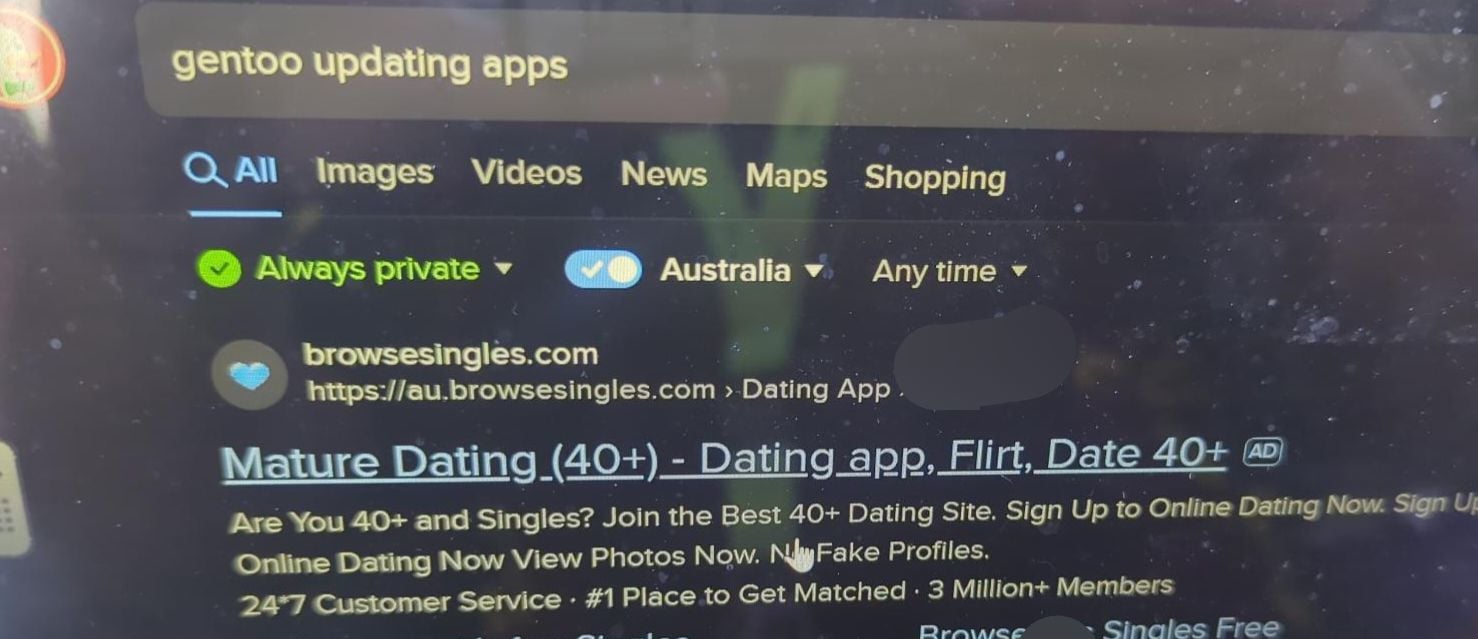
On a more serious note, how does updating apps on gentoo work? I understand that everything is built on your system, but then if the app is updated, do you need to re-compile every time?
DuckDuckGo doesn’t track your activity so they only target ads based on your current query and technical details. They determined it would take 30 years to compile Gentoo on your rig so 40+ is a good guess for your age.
I didn’t start using Gentoo when I was 10. Is it over for me?
How are you expecting to get 10 years of experience for your entry-level job by age 20? You need that to succeed in the job market, and let me guess, you also wasted so much potential by passing up on that opportunity of being born to Linus Torvalds.
Just two things:
- You can take screenshots with your computer.
- Clean your damn monitor, son! 🤣
Work computer. Dont want to sign in to work computer with personal accounts. Yes, can screenshot, then email to myself, open up on phone, then upload here. But thats too much work for a dumb joke.
Why are you using dating websites on work computers?
if OP is using gentoo then there is a very real chance they aren’t able to take screenshots yet.
back in my gentoo days it took a while to get that set up. although it wasn’t exactly a top priority
running
emerge -qg scrot’s not a lot of work
That ad is targeted perfectly.
do you need to re-compile every time?
emergecompiles for me. I never have to run make myself.And now there’s the official binhost. Not even emerge needs to compile.
Yes, you recompile each time you update.
In general, to upgrade an app you do:
root # emaint --auto sync
root # emerge --update $PACKAGE_NAME(That first command used to just be something like
root # emerge --syncwhen I last used Gentoo, two decades ago. I wonder why they changed it?)Wouldnt that take a long time every update? Or are all the horror stories of long compile times just a thing of the past with better hardware now?
Well, yeah, but that’s what you sign up for when you choose to use Gentoo. Custom-compiling every app, every time, with your chosen USE flags, is the advantage of it. (I suppose Gentoo has “binary packages” available now, but at that point I don’t see why you wouldn’t just pick Arch instead to begin with.)
Also, that’s another reason you should update frequently (e.g. daily or weekly): to keep compilation times reasonable by only ever updating a few packages at once.
Also also, as I said, I last used Gentoo two decades ago. Even back then, I found the compilation times… uh, at least “tractable.” 😅 I can only assume that with modern hardware they’re not bad at all, as for the most part, processing power has scaled faster than FOSS code complexity.
It’s not gentoo late, bro!
I started. Got a headache. Maybe its just user error and i didnt read the full handbook before starting, or just a very wordy handbook, but each step lists the systemd steps AND the openrc steps. Instead of one book for just openrc and another for systemd.
Will read again tomorrow, and spin up another vm next weekend for attempt number 2
Yeah, Gentoo is really tough to use if you’re not somewhat familiar with Linux, it’s ins and outs, and its general ecosystem. Even the handbook assumes a lot of knowledge. But when you get it operating… boy is it rewarding. It’s like difficult hike—you’re wrung out, but you’re stronger from it in the long-run, and the view is amazing.
You know, I’d recommend starting with Arch, actually. It’s got challenges of its own, but a manual Arch install can help familiarize yourself with the Linux install process in general, and can help ease you into the Linux-from-Scratch-with-training-wheels that is Gentoo. And the documentation (ArchWiki) is famous for how helpful and informative it is. It’s definitely better than the Gentoo Handbook on that front!