

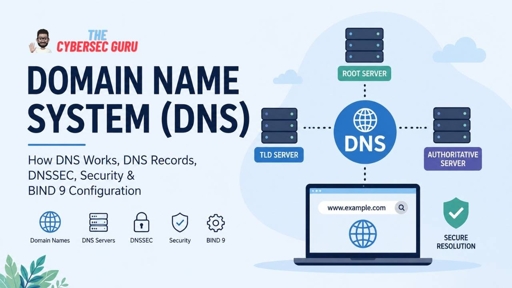
DNS is one of the Internet’s most fundamental services, yet it’s often reduced to “it converts domain names into IP addresses.” In reality, there’s much more happening behind every DNS lookup. I wrote an extensive guide that starts with the fundamentals and progressively moves into modern DNS architecture, security, and administration. It covers the complete DNS resolution process, recursive and authoritative servers, resource records, packet-level analysis, DNSSEC, encrypted DNS (DoH, DoT, and DoQ), common attack techniques such as cache poisoning, tunneling, rebinding, and amplification attacks, as well as deploying and securing a production-ready BIND 9 DNS server. The goal was to explain not only how DNS works, but also why it was designed this way and how it is operated and secured in modern networks.