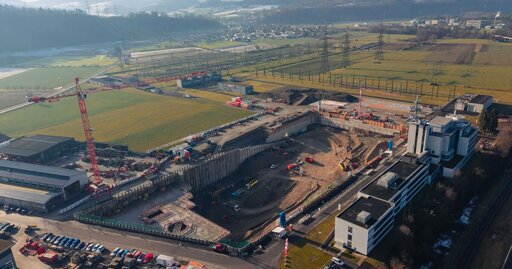
In northern Switzerland, a construction team is hard at work excavating a hole in the ground that will end up being over 88 ft (27 m) deep, and spanning the length of two soccer pitches. This pit will be home to Switzerland's first redox flow battery for storing clean energy – and it'll be the most…


Care to offer a correct translation?
It’s just about 1.2 GW of power
Sure, a random translation site gives “We can inject or absorb up to 1.2 gigawatts of electricity in milliseconds, the equivalent of the power of the nucleus plan”, one assumes nucleus plan goes to nuclear plant.
It’s the use of 1.2 GW in milliseconds that is at question as it’s close to physically impossible and would impress the guys who made CERN.
Still super cool if it’s actually just 1.2GWh in a pit (with a reasonable lack of toxicity), personally happy to call it a win with some overzealous reporting / marketing and forget about the whole milliseconds bit.
What’s a common timeframe for a utility-scale battery storage to start providing power? I heard that this type is the best in responsiveness, though I don’t have the exact numbers. A quick search shows me numbers up to 50 milliseconds though.
The phrasing in French suggests they can start injecting that power in millisecond and they have 1.2GW/h capacity
Ah, now it makes sense. Thanks.